English
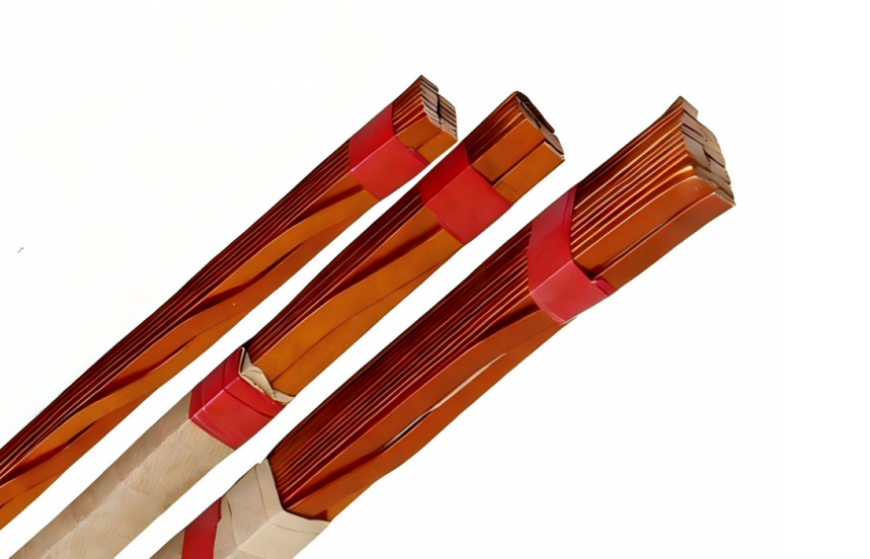
Transposed Conductor
Transposed Conductor
Brief Introduction
Transposed conductor is a special composite magnet wire. It consists of multiple enameled rectangular copper wires (normally an odd number ranging from 5 to 71 strands) arranged in two rows, continuously woven with regular 360° transposition, and tightly wrapped with electrical insulating paper on the outer layer. Internal transposition balances the leakage flux linkage and resistance of each strand, greatly reducing additional losses under heavy current. It serves as the core winding material for large-capacity transformers and reactors.
Core Features
Ultra-low additional loss: Continuous internal transposition cuts eddy current and circulating current losses by 40%–50%, markedly improving transformer efficiency
Excellent heat dissipation: Thin insulation and compact structure lead to low hot-spot temperature rise, suitable for long-term heavy-load operation
High mechanical strength: Tightly woven multi-strand structure with overall wrapping delivers strong resistance to short-circuit impact, vibration and deformation
High slot fill factor: Regular dimensions and thin insulation raise space utilization rate by 20% for more compact winding layout
Simplified processing: No manual transposition required during winding; it can be handled as a single conductor for higher production efficiency
Stable performance: Oil-resistant, heat-resistant and anti-aging, compatible with both oil-immersed and dry-type transformer operating environments
Application Scenarios
Large power transformers: Medium and low-voltage windings for 110kV–1000kV EHV/UHV main transformers and oil-immersed transformers
New energy transformers: Step-up transformers for wind power and photovoltaic power generation, energy storage converter transformers, special nuclear power transformers
Rail transit: Windings for high-speed railway and metro traction transformers, capable of enduring heavy current surges with high reliability
Reactors & instrument transformers: Windings for shunt reactors, current-limiting reactors and high-voltage instrument transformers
Special industrial equipment: Furnace transformers, rectifier transformers, large motors and superconducting magnet windings
High-voltage electrical equipment: Windings for converter transformers, high-voltage reactors and large-capacity dry-type transformers