English
Composite Conductor
Composite Conductor
Brief Introduction
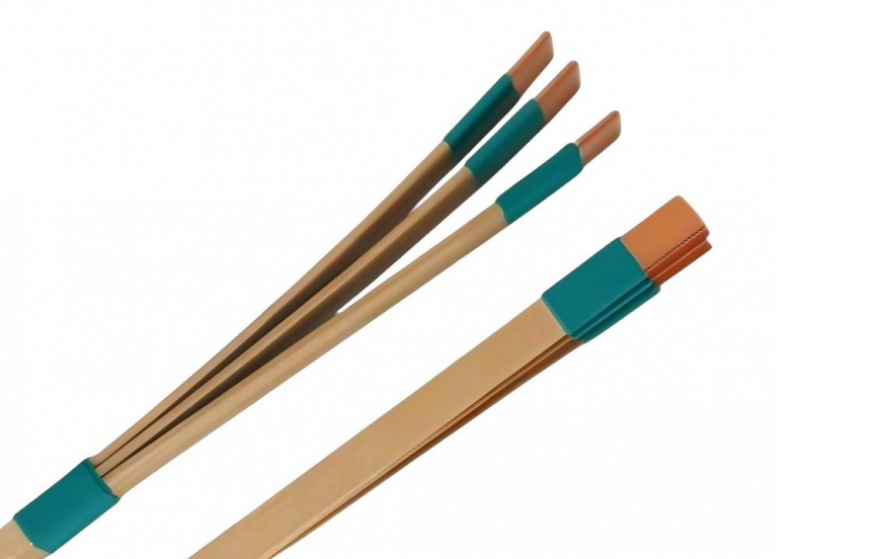
Composite conductor is a high-current winding conductor assembled by 2 to 4 enameled or paper-covered rectangular copper wires arranged side by side or stacked together. Each individual wire is coated with thin insulation, and the entire assembly is wrapped externally with electrical insulating paper (cable paper / Nomex paper). Featuring neat configuration and high fill factor, it is specially developed for medium and low-voltage high-current windings of large-capacity transformers.
Core Features
Superior current-carrying capacity: Parallel strands enable large current transmission and lower resistive loss
High slot fill factor: Thin insulation on individual strands and compact overall structure boost space utilization rate by 15%–25% compared with separately wound multiple wires
Favourable mechanical strength: Great overall rigidity, excellent resistance to short-circuit impulse and deformation, stable performance during winding fabrication
Convenient processing: Can be wound as a single conductor; manual transposition is unnecessary, greatly improving processing efficiency
Uniform heat dissipation: Thin inter-strand insulation facilitates heat conduction and even temperature rise across the winding
Reliable insulation: Thin inner insulation paired with robust outer wrapping ensures stable interlayer insulation, suitable for both oil-immersed and dry-type transformers
Application Scenarios
Large power transformers: Medium & low-voltage high-current windings for 110kV–500kV main power transformers
Distribution transformers: Low-voltage windings of large-capacity distribution transformers rated 35kV and below
New energy transformers: Wind power & photovoltaic step-up transformers, energy storage converter transformers
Special industrial transformers: Furnace transformers, rectifier transformers, traction transformers and reactor windings
Alternative application: Windings carrying heavy current where continuous transposition is not required and loss requirements are less stringent than those for transposed conductors